
(Na,Ca,?)ZrSi · 2H
Over the years, Mont Saint-Hilaire has produced the largest crystallized specimens of catapleiite, making it the most sought after species after sérandite.
PHYSICAL CHARACTERISTICS:
Color varies from tan to beige to pale gray to brown to colorless; very
rarely pale yellow, pale orange, pink and very pale blue in small
crystals.
Luster is vitreous; many crystals are coated with thin film that reduces
the luster and gives some iridescence to the crystals.
Diaphaneity is transparent to translucent to opaque.
Crystal System is monoclinic (pseudo-orthorhombic, pseudo-
hexagonal);2/
Crystal Habits include excellent hexagonal shaped plates, sometimes
forming stacked rosettes; at least six twin laws are reported.
Cleavage {100} is perfect.
Fracture is conchoidal.
Hardness is 5.5
Specific Gravity is approximately 2.8 g/cm
Streak is white.
Associated Minerals include aegirine, albite, amphiboles, analcime,
ancylite, ankerite, astrophyllite, calcite, donnayite, fluorite, magnetite,
natrolite, polylithionite, pyrochlore, rhodochrosite, siderite and
sphalerite.
Distinguishing Features Pseudo-hexagonal paty crystal habit.
Origin: Named in 1851 from Greek kata, with and pleion, more, alluding
to its association with a number of rare minerals.
CLASSIFICATION:
Dana System
# 59.2.2.1
Strunz Classification
# VIII/E.4-10
REFERENCES:
CanMin 16:195-198 (1978), MinRec 21:284 (1990),
Dana 8:1226-1227 (1997)
DISTRIBUTION AND RARITY AT MONT SAINT-HILAIRE:
MSH
¤¤¤
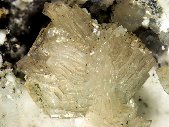
Catapleiite
Photo by Modris Baum
© Modris Baum
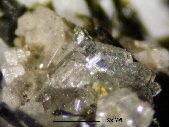
Catapleiite crystals
Photo by Doug Merson
© Doug Merson
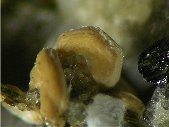
Catapleiite crystals
Photo by Stephan Wolfsried
© Stephan Wolfsried
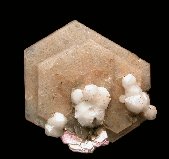
Catapleiite
Photo by Gilles Haineault
© Gilles Haineault
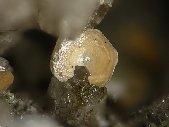
Catapleiite crystals
Photo by Stephan Wolfsried
© Stephan Wolfsried
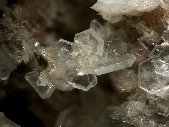
Catapleiite crystals
Photo by Stephan Wolfsried
© Stephan Wolfsried
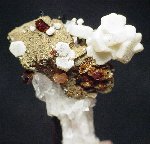
Catapleiite crystals
Photo by R. Lavinsky
© www.irocks.com
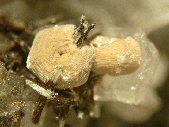
Catapleiite “donuts”
Photo by Bill Lechner
© Bill Lechner