
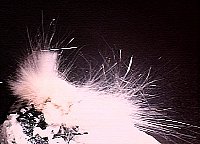
Ashcroftine-(Y) had been originally described as kalithompsonite in 1924. MSH is only the second locality for this species which has the distinction of having the largest unit-cell dimensions of all known species.
PHYSICAL CHARACTERISTICS:
- Color is usually very pale violet, pale pink or white.
- Luster is vitreous to silky.
- Diaphaneity is transparent to translucent.
- Crystal System is tetragonal; I4/mmm.
- Crystal Habits include very fine divergent sprays and tufts of
randomly oriented capillary to fibrous crystals to 20mm.
- Cleavage {100} is perfect and {001} is good.
- Fracture is uneven.
- Hardness is 5 – 5.5.
- Specific Gravity is approximately 2.25 g/cm3.
- Streak is white.
- Associated Minerals include aegirine, albite, amphibole group,
analcime, ancylite, bastnäsite, biotite, brookite, catapleiite,
cordylite, donnayite, elpidite, ewaldite, fluorapatite, fluorite,
leucophanite, leucosphenite, lorenzenite, microcline,
molybdenite, monteregianite, narsarsukite, nepheline, raite
and zircon. - Distinguishing Features: Crystal habit and color.
- Origin: Named in 1933 for Frederik Noel Ashcroft (1878-1949),
a proeminent mineral collector of London.
| Dana class # | 70.3.1.1 – Inosilicates: two-dimensionally infinite silicate units; column or tube structures |
| Strunz class # | VIII/F.35-60 – Inosilicates (chain and band) complex chain structure; cylindric chains and others; ashcroftine-(Y) series |