
Thumbnails
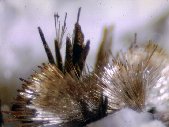
Lorenzenite crystals
L. Horváth sp.
Photo by Violet Anderson
© Royal Ontario Museum
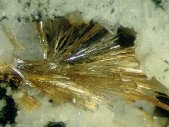
Lorenzenite crystals
Photo by Violet Anderson
© Royal Ontario Museum
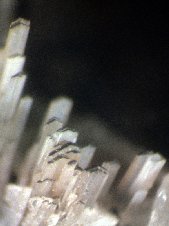
Lorenzenite crystals
© Modris Baum
NaTiSi14
Lorenzenite is fairly common at MSH. This species is very similar in morphology and color to vinogradovite, in both the bladed and fibrous habits and to ashcroftine in the fibrous habit. Lorenzenite is far more abundant and it fluoresces under SW.
PHYSICAL CHARACTERISTICS:
Color is pale violet, pink, grayish pink, white to colorless and
dark reddish brown.
Luster is vitreous to silky on bladed crystals and silky on
acicular crystals.
Diaphaneity is transparent to translucent.
Crystal System is orthorhombic;
Crystal Habits include superb sword-shaped, bladed crystals and
very thin fibrous acicular crystals to 1.5 cm.
Cleavage {100} is perfect and {110} is good.
Fracture is uneven.
Hardness is 6
Specific Gravity is approximately 3.45g/cm
Streak is white.
Associated Minerals include aegirine, albite, amphibole group,
ashcroftine, bastnäsite, biotite, burbankite, calcite, chlorite group,
elpidite, fluoroapatite, leucophanite, microcline, molybdenite,
monteregianite, narsarsukite, pectolite, pyrite, quartz, siderite,
stillwelite, titanite and yofortierite.
Distinguishing Features: Fluoresces pale yellowish white under SW.
Luster and radiating crystal habit.
Origin: Named in 1897 for Johannes Theodor Lorenzen (1855-1884),
Danish mineralogist and student of Greenland mineralogy.
CLASSIFICATION:
Dana System
# 65.1.6.1
Strunz Classification
# VIII/F.03-50
REFERENCES:
MinRec 21:319 (1990), AmMin 72: 173-177 (1987), Dana 8:1312 (1997)
DISTRIBUTION AND RARITY AT MONT SAINT-HILAIRE:
MSH
¤¤¤
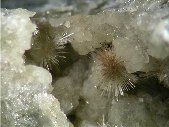
Lorenzenite crystals
© Stephan Wolfsried
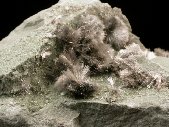
Lorenzenite crystals
© Gilles Haineault
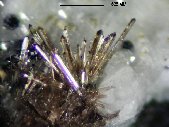
Lorenzenite crystals
© Doug Merson